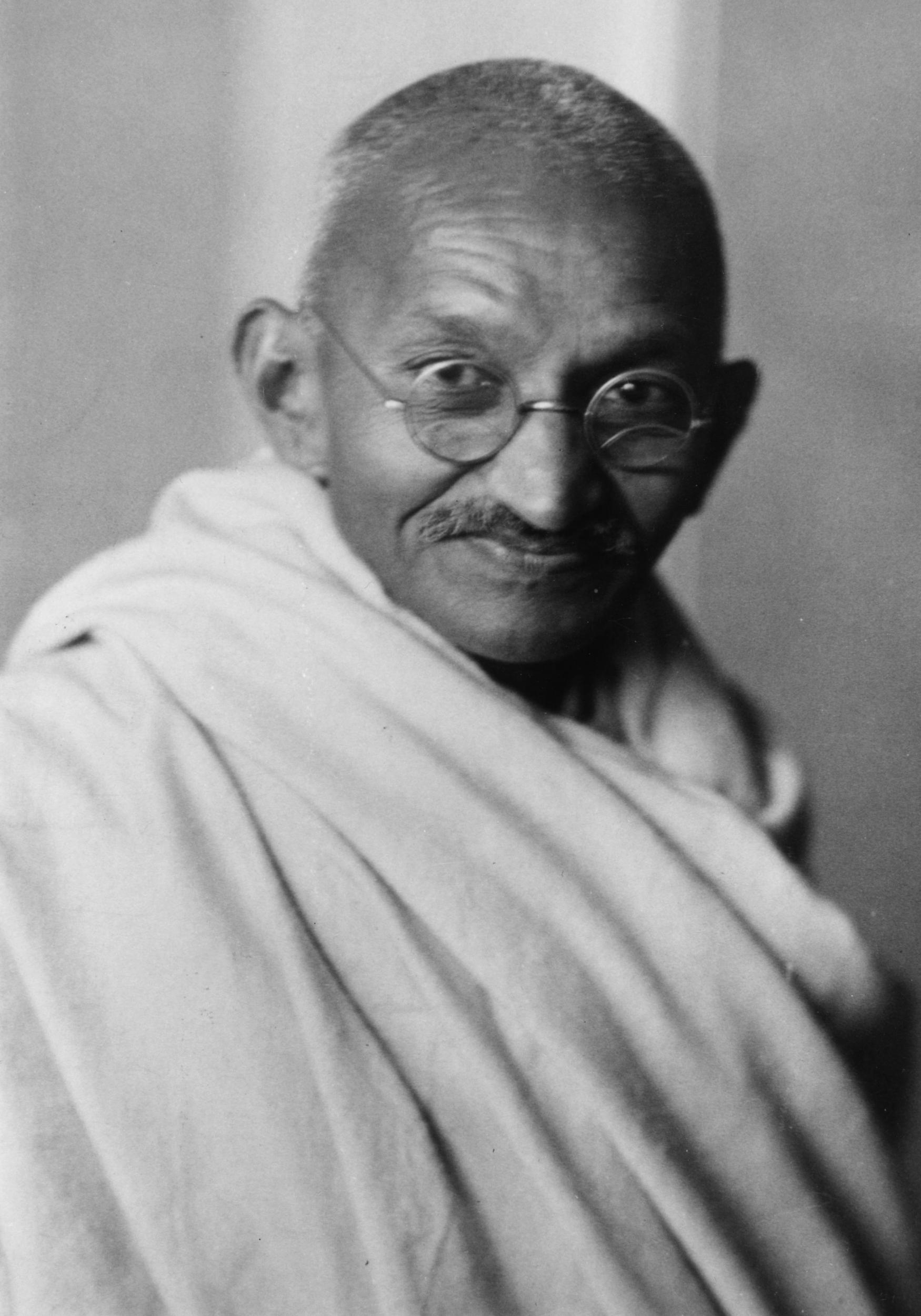
1931 portrait of Mohandas Gandhi wearing round glasses and a shawl

A story for Gandhi Jayanti · 2 October

What can one person make possible?

A shy lawyer became the face of a freedom movement. He did it without leading an army. How did he persuade millions to act—and what did that way of living cost him and those close to him?

Gandhi, 1931. Elliott & Fry. Image record ↗

Opening credits / the person

Before the name became a symbol.

His name was Mohandas Karamchand Gandhi. “Mahatma” is an honorific meaning “great soul”; “Bapu” means father. He was born in a coastal town, trained as a lawyer in London, found his political voice in South Africa, and returned to India in 1915. The public story began inside an ordinary, complicated family life.

Born2 October 1869Porbandar, present-day Gujarat
Died30 January 1948New Delhi, aged 78; assassinated
At homeKasturba and four sonsHarilal, Manilal, Ramdas and Devdas
Known forSatyagrahaCollective, open resistance without attacking an opponent

Start with the Gandhi Smriti chronology, the Porbandar birthplace record, and the meaning of “Mahatma”.

The central question

Why did people follow him?

He gave ordinary people a part in a struggle that had often seemed reserved for leaders. You did not need a weapon or a seat in government. You could refuse an unjust pass, join a march, stop buying imported cloth, or make your own.

His real power was organised trust. He listened, wrote, travelled, made promises in public and asked others to keep them. When he asked people to take a risk, he usually took one too.

That method could move a country. It could also disappoint allies, place pressure on people who disagreed, and fail to stop violence. The ten scenes below hold both truths together.

The feature / ten scenes

A life told through decisions.

Every scene asks what happened, what Gandhi did, and what that choice tells us. The links are there so you can follow the evidence yourself.

Act I

A young man learns to resist.

The legend starts with a train. The leader takes years to form.

1893 · South Africa · The beginning

A cold night at Pietermaritzburg

Gandhi was 23 and working as a lawyer. He had a first-class ticket for a journey to Pretoria. At Pietermaritzburg, railway staff told him to move because he was Indian. He refused and was put off the train. He spent the night in a cold waiting room.

He considered going home. Instead, he stayed to challenge the discrimination faced by Indians in South Africa. He would spend two decades learning how to organise a community: meetings, newspapers, petitions, court cases, negotiation and, eventually, open defiance.

  • The injusticeA ticket did not protect him when a racist rule was enforced.
  • His choiceHe stayed and turned a personal wound into public work.
  • What to rememberThis was a beginning, not an instant transformation into a national hero.

Perseverance became leadership only when he organised with others.

Go deeper: His account of the journey · chronology

1906–1913 · South Africa · Persuasion

A promise people could keep together

A registration law required Indians in the Transvaal to carry papers and show them on demand. Gandhi helped bring Indians and Chinese residents together to pledge that they would resist even if resistance meant prison.

When a promised repeal did not come, more than 2,000 certificates were burned publicly in 1908. Women and mine workers later helped carry the struggle into the 1913 strikes. Gandhi called the approach satyagraha: hold to what you believe is true, break the unjust rule openly, and accept the penalty.

  • The designA written pass became a visible object that could be refused.
  • The costPeople risked jail, wages and family security.
  • The peopleWorkers, women, Indian and Chinese resisters gave the campaign its strength.

His gift was making a hard choice possible for many people at once.

Go deeper: The burning of the passes · the wider campaign

Act II

He comes home and learns to listen.

He returned to India in 1915. Gopal Krishna Gokhale advised him to spend time observing the country before trying to lead it.

1917 · Bihar · Listening

A farmer would not let him forget Champaran

Raj Kumar Shukla kept asking Gandhi to visit Champaran. Indigo farmers there said planters were exploiting them. Gandhi finally went, listened to tenants and began collecting their accounts.

Officials ordered him to leave. He refused, appeared before a magistrate and was prepared to face the penalty. The case was withdrawn. The government set up an inquiry; Gandhi joined it on the tenants’ side. His team also worked on schools and sanitation.

  • Who opened the doorShukla, the farmer, knew the local problem and insisted that it be heard.
  • What Gandhi addedHe gathered testimony and made it difficult for officials to look away.
  • Why it lastedThe work moved beyond one protest into reform and village service.

Leadership can begin by following the person who knows the problem best.

Go deeper: April 1917 record · the inquiry

1918 · Gujarat · Judgment

Two problems, two different answers

In Ahmedabad, mill workers wanted higher wages. Gandhi studied their case and suggested a 35% demand. He asked them to strike peacefully and keep their promise; as their resolve weakened, he fasted.

In nearby Kheda, failed crops made land tax impossible for many farmers. Gandhi and local organisers used the government’s own revenue rules to argue for relief. These campaigns were linked, but he did not use the same tactic in both.

  • AhmedabadUnderstand the wage dispute, then support a disciplined strike.
  • KhedaShow the crop failure and ask farmers to stand together on a legal claim.
  • The hard questionEven a sincere fast can put heavy pressure on others.

He mixed moral conviction with facts, rules and local organising.

Go deeper: His account of Ahmedabad · his account of Kheda

Act III

An entire country becomes the stage.

The challenge was no longer how to win one local case. It was how to give millions a part in the demand for self-rule.

1919–1921 · India · Mass leadership

The protest entered ordinary homes

The Rowlatt laws let the colonial state keep wartime powers over civil liberties. Gandhi called for a nationwide hartal: a day when people would stop ordinary work as a sign of protest.

The later non-cooperation movement asked people to return official titles, leave colonial institutions, boycott foreign cloth and wear cloth made in India. His newspapers carried the case from town to town. Suddenly a student, worker or shopkeeper could take part without waiting for a leader to arrive.

  • The insightA government runs partly because people take part in its routines.
  • The invitationWithdraw that cooperation in public, together.
  • The problemAt national scale, leaders could not control every crowd.

He turned the idea of freedom into choices people could make each day.

Go deeper: Gandhi Smriti chronology

1922 · Chauri Chaura · Principle under strain

He stopped a movement he had built

At Chauri Chaura, a crowd set a police station on fire and killed policemen. Gandhi ended the mass civil disobedience campaign. He believed a movement claiming nonviolence could not excuse violence because its cause was just.

Many supporters were shocked. After years of work, they thought independence might be near. Gandhi feared that continuing without enough discipline would change the movement into something he could not defend.

  • Why some trusted himHe applied his rule when it hurt his own campaign.
  • Why others objectedThey questioned whether one local crime should stop a national struggle.
  • What it revealsHis moral authority also gave him great power over fellow Indians.

The most revealing decision of a leader may be the one that disappoints followers.

Go deeper: Gandhi Smriti, 1922

Act IV

A small act makes the empire answer.

Gandhi looked for a rule everyone could understand, and a way to break it that anyone could copy.

1930 · Sabarmati to Dandi · Strategic imagination

Why salt worried British rulers

Salt was needed in every kitchen, but British law controlled and taxed it. Gandhi chose it as the target of civil disobedience. On 12 March he set out from Sabarmati with 78 companions and walked about 241 miles to the sea.

At Dandi he broke the salt law. Others could do the same wherever they lived. The government now had to decide whether to ignore public lawbreaking or punish people for making something as ordinary as salt.

  • A clear symbolSalt joined rich and poor in a way an abstract demand could not.
  • A long journeyThe march gave villages and reporters time to meet the campaign.
  • A dilemma for rulersEvery arrest could make the law look less defensible.

The action was small. Its invitation to millions was enormous.

Go deeper: Rajghat chronology · British Library campaign file · image record

1931 · England · Respect across a divide

He met the people hurt by his boycott

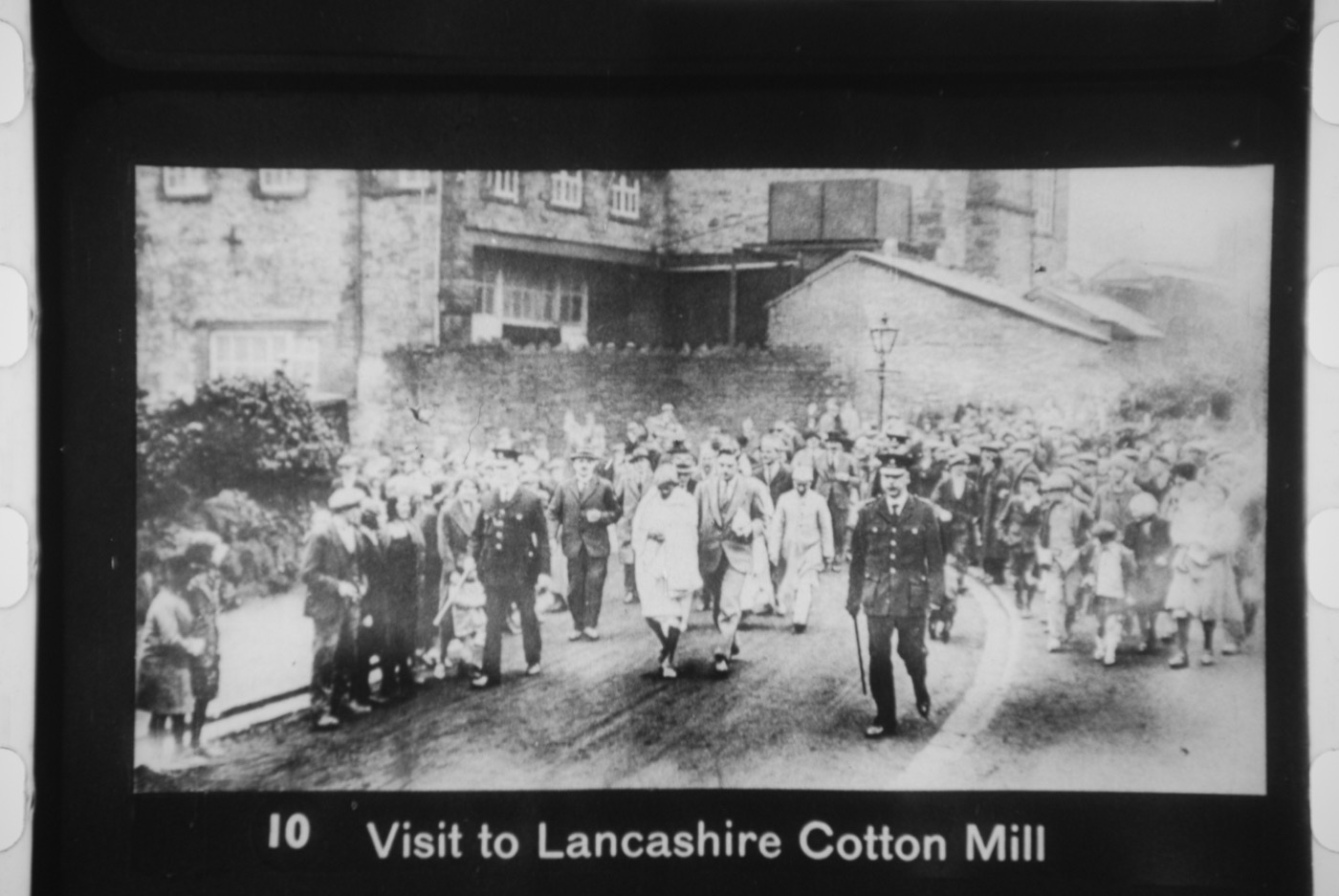
After the Gandhi–Irwin Pact, he travelled to London for talks on India’s future. He wore homespun cloth and stayed at Kingsley Hall in the East End. He also went to Lancashire, where cotton workers faced unemployment and feared the Indian boycott of British cloth.

He met workers and industry representatives rather than treating them as enemies. He did not give up the argument that Indians needed work and self-rule. The visit shows an unusual balance: resist a government firmly, but speak to ordinary people on the other side as people.

  • Why the visit matteredIt brought the cost of the boycott into the same room as India’s poverty.
  • What he could offerA frank explanation and goodwill, though no easy answer for lost jobs.
  • What happened nextThe conference did not give India independence.

He was against colonial rule, not against every British person.

Go deeper: Gandhi Heritage Portal, Lancashire visit · UK National Archives

Act V

Freedom forces harder questions.

A strong leader can be wrong about who should speak for others. And political victory cannot by itself end hatred.

1932 · Yerwada prison · A dispute about power

Ambedkar asked who would speak for Dalits

B. R. Ambedkar wanted political safeguards that would let people then officially called the “Depressed Classes” choose representatives with real independence. Gandhi opposed separate electorates for them and began a fast in prison.

The Poona Pact kept a joint electorate but set aside seats. Gandhi saw himself defending social unity and fought untouchability—the caste practice of treating some people as impure. Ambedkar argued that goodwill from higher-caste Hindus was no substitute for political power held by Dalits, people oppressed by caste. The fast placed huge pressure on the negotiations.

  • What Gandhi fearedA separate electorate might harden divisions within Hindu society.
  • What Ambedkar fearedA joint electorate could leave oppressed people dependent on the majority.
  • Why we remember itFreedom must include the power to speak for oneself.

To understand Gandhi honestly, listen to the person who refused his answer.

Go deeper: Ambedkar’s writings · historical study

1942–1948 · India · The final test

Freedom came. Peace did not.

In 1942 Congress demanded that Britain leave India. Gandhi and other leaders were jailed. During detention, his secretary Mahadev Desai died and his wife Kasturba died after a long illness.

In 1946 Gandhi walked through villages in Bengal after violence between religious communities. On 15 August 1947, British rule ended. Partition created India and Pakistan, and forced millions to leave their homes. Gandhi was in Calcutta, working to stop killings. He later fasted for peace there and in Delhi. He was assassinated in Delhi on 30 January 1948.

  • The perseveranceHe did not treat independence as the end of his duty.
  • The limitHe could not prevent Partition or all the violence.
  • The final messageA free country still has to protect its neighbours.

The last campaign was not against Britain. It was against hatred among Indians.

Go deeper: Chronology · his last 144 days
Behind the scenes / the method

How did he move people?

His best-known word, satyagraha, joins truth with firm action. It asks people to resist an unjust rule openly, avoid harming an opponent, and accept the risk themselves. It is much more demanding than simply “doing nothing.”

1

Listen first.

In Champaran and Kheda, he gathered accounts and learned the rules before asking others to act.

2

Choose one clear act.

A pass, a piece of cloth or a handful of salt made a large injustice easy to see.

3

Share the risk.

He asked for public promises and accepted prison. Followers could see the price was real.

4

Leave room to talk.

Even after defiance, he met opponents. He wanted a changed rule and a different relationship.

These four steps are our reading of the events above, not a formula Gandhi published. They worked only because many other people organised, wrote, marched and endured the consequences with him.

The people around him

He was shaped by argument, friendship and refusal.

Calling one person “the father of a nation” can hide the people who taught him, challenged him and carried the work. These relationships make his decisions easier to understand.

Mentor · G. K. Gokhale

First, learn India.

After Gandhi returned in 1915, Gokhale advised him to observe and study the country. Gandhi took that counsel seriously before his first major Indian campaign.

January 1915 record ↗
Friend and critic · Rabindranath Tagore

A poet who said no.

Tagore questioned non-cooperation and Gandhi’s emphasis on the spinning wheel. Gandhi answered him in public. Their respect survived disagreement.

Read Gandhi’s reply ↗
Political heir · Jawaharlal Nehru

Not the same dream of India.

Gandhi named Nehru his political successor in 1942. They shared the goal of freedom but differed over the place of villages and modern industry in India’s future.

Read Nehru’s reply to Gandhi ↗
Rival strategy · Subhas Chandra Bose

A different road to freedom.

Bose wanted a more forceful struggle and later led the Indian National Army. Gandhi insisted on mass nonviolence. Bose won the Congress presidency again in 1939, then resigned amid conflict with Gandhi’s allies.

Compare their methods ↓
Gandhi meeting textile workers during his 1931 Lancashire visit
1931 image record ↗

A relationship across the empire

He argued with Britain, and spoke with Britons.

Gandhi studied law in London. Years later he challenged British rule in India. In 1931 he went to Lancashire to face textile workers whose livelihoods were touched by India’s boycott. He could recognise their hardship without giving up the claim that Indians needed control over their own work.

Earlier, in South Africa, he had fought laws defended by Jan Smuts, then sent him sandals he had made in prison. Smuts later remembered their clash with respect. Gandhi’s point was that resisting a policy did not require hating the person who enforced it. It did not make the policy less harmful.

Lancashire records · Smuts and the sandals

Two roads / Gandhi and Bose

They wanted freedom. They differed on the means.

Neither man tells the whole independence story alone. Their disagreement helps explain the choices available to leaders in the 1930s and during World War II.

Question
Gandhi
Bose
How to resist?

Mass non-cooperation and open civil disobedience, with a rule against violence.

A more militant struggle, later including the Indian National Army.

What about World War II?

Would not seek freedom through an alliance with Nazi Germany or imperial Japan.

Sought help from Britain’s wartime enemies to fight colonial rule.

What happened in Congress?

His supporters opposed Bose’s second term as Congress president in 1939.

Won reelection but resigned when he could not work with the party leadership.

The conflict was political and personal, but it did not erase a shared demand for Indian independence. UK National Archives · Bose’s account

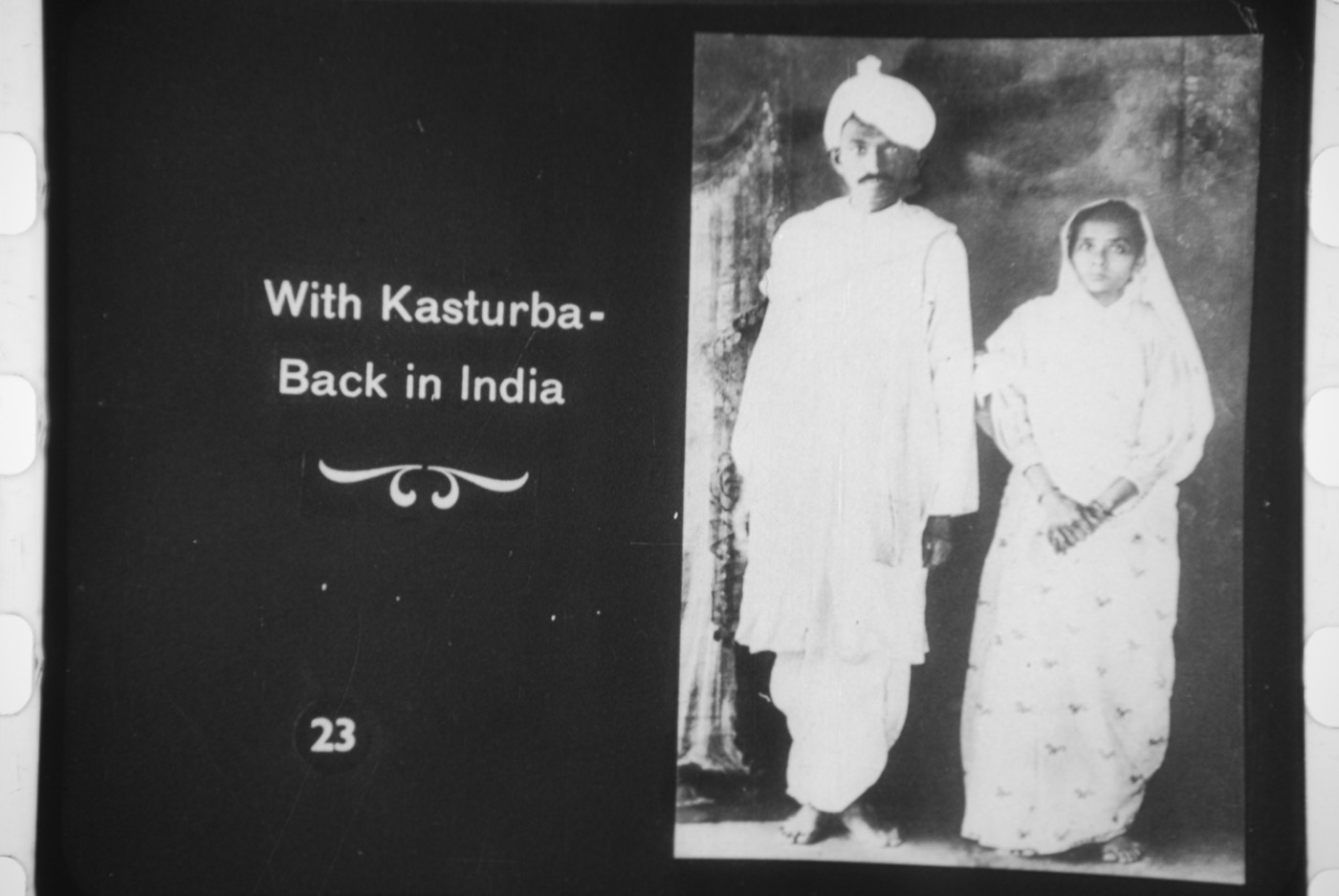
Gandhi with Kasturba Gandhi in 1915
Gandhi and Kasturba, 1915. Image record ↗

Behind the public life

He had a family. His choices reached them too.

Gandhi and Kasturba married as children, when both were about thirteen. They raised four sons. Gandhi later wrote frankly about his jealousy as a young husband. The public “Bapu” had to learn how to be a better person at home as well as in politics.

Kasturba was not simply beside him in photographs. She joined the struggle, ran parts of ashram life and went to prison. She died in detention in 1944. Their eldest son Harilal struggled with the demands of his father’s ideals, and the relationship became painful. A life offered to public service also placed burdens on the family.

  • A shared struggleKasturba resisted in South Africa and India. The movement drew on her labour and courage.
  • A demanding householdAshrams made private habits—food, work, cleanliness, prayer and money—part of a public experiment.
  • A difficult father-son bondHarilal’s estrangement reminds us that Gandhi’s rules did not feel equally fair to everyone close to him.

Gandhi on his young marriage · Kasturba’s life · family biography

The everyday Gandhi

What did his days look like?

The white cloth and spinning wheel were not props. He tried to make daily life express the politics he asked others to practise.

01

White khadi

From 1921 he wore a loincloth and homespun cloth. It connected his appearance to the poor and to village spinning. The sources explain that choice; they do not establish a personal “favourite colour.” Source ↗

02

Food as experiment

He was vegetarian and changed his diet repeatedly. Recorded meals include fruit, vegetables, dates and goat’s milk. One 1934 account lists oranges, grapes, salads and dates. That is evidence of what he ate, not proof of a single favourite dish. Source ↗

03

Writing and work

He edited newspapers, wrote letters, spun cotton and joined manual work at the ashram. His constructive programme included sanitation, education, village industries and communal unity. Source ↗

An honest detail is often more interesting than a made-up “favourite”: Gandhi’s diet changed with his health and convictions; his white clothing was a choice with a political meaning.

Where to meet the history

Four places you can still visit.

These places tell different parts of the life: a birth, a home, a village chosen for work and the room where it ended. Check each site's current visitor details before travelling.

Porbandar · Gujarat

Kirti Mandir and the family house

The Gandhi family house where Mohandas was born stands beside the memorial to him and Kasturba.

Official place record ↗
Ahmedabad · Gujarat

Hriday Kunj, Sabarmati Ashram

His home at the ashram. He left from Sabarmati for the Salt March in 1930.

Ashram record ↗
Sevagram · Maharashtra

Bapu Kuti

The village home he chose in 1936 to stay close to the work of rural reconstruction.

Ashram record ↗
New Delhi

Gandhi Smriti

The former Birla House preserves his final room and the place where he was killed. Rajghat is the separate memorial at his cremation site.

Gandhi Smriti ↗ · Rajghat ↗

The questions we should keep

A complete memory can hold criticism.

Admiration does not require silence about harm or disagreement. These questions belong beside the achievements.

Race in South Africa

Some of Gandhi’s early words about Black Africans were racist. His views changed, but later solidarity does not erase the earlier words. Historical discussion ↗

Caste and political power

He opposed untouchability. Ambedkar still challenged his right to decide the political future of Dalits. The Poona Pact remains a debate about representation and pressure. Ambedkar’s writings ↗

Control of a movement

Chauri Chaura and the conflict with Bose show how much influence Gandhi held over other leaders. They did not always welcome his decisions. Bose’s perspective ↗

Private discipline and power

Later in life, Gandhi involved young women in controversial tests of his vow of celibacy. Historians question the practice and the power imbalance. His willingness to call something an “experiment” did not make it beyond criticism. Scholarly study ↗

How this page was written: Dates and events have source links. A sentence about what a decision “reveals” is an interpretation. Gandhi did not free India alone, and people who opposed his views deserve to be heard in their own words.

After the final scene

The idea travelled farther than he did.

Gandhi did not invent the wish to resist injustice without violence. His campaigns showed later organisers a way to turn that wish into shared action. They adapted it to their own places and struggles.

Martin Luther King Jr. learned from the method.

King drew on Gandhi’s approach during the Montgomery bus boycott and later visited India in 1959. He joined those ideas with the work of Black churches, organisers and communities fighting segregation in the United States. King Institute at Stanford ↗

His birthday became a day for nonviolence.

The United Nations chose 2 October, Gandhi’s birthday, as the International Day of Non-Violence. Its purpose is to spread the idea through education and public awareness. That is a reason to ask what his actions can teach us now, alongside what he got wrong. United Nations ↗

One person cannot free a country alone. One person can help millions see what they can do together.

Remember the method. Question the man. Continue the work.

Reading room / continue the journey

Read beyond this page.

Use the links inside each scene for the exact claim. These collections give a broader view, including Gandhi’s own writing and accounts from people who challenged him.

  1. Collected Works of Mahatma Gandhi — letters, speeches and writing.
  2. The Story of My Experiments with Truth — his autobiography.
  3. Rajghat chronology — a dated outline.
  4. Gandhi Smriti chronology — movements and final years.
  5. South African History Online — the early campaigns and other participants.
  6. UK National Archives — British government records and context.
  7. B. R. Ambedkar’s writings — a vital challenge to Gandhi.
  8. Subhas Chandra Bose’s account — the 1939 Congress split.

Images: portrait, Dandi, Gandhi and Kasturba, and Lancashire. Their Commons pages state the license and origin. The Dandi photograph is used as atmosphere; the dated scene is sourced separately.